


The best financial intermediaries do not begin with a product. They begin with the person, the problem and the purpose behind the money.
Imagine visiting a doctor with a headache and receiving a prescription before you have even finished describing the problem.
No questions about how long the pain has lasted. No check-up. No attempt to understand whether the cause is stress, dehydration, poor eyesight or something more serious.
It would feel careless because the same symptom can point to very different conditions.
Financial conversations work the same way.
When an investor says, "I want higher returns," that is not a complete financial requirement. It may be a symptom of an approaching goal, anxiety about inflation, inadequate savings, comparison with a friend’s portfolio or an unrealistic expectation created by social media.
The product is rarely the starting point.
The diagnosis is.
That is why every financial intermediary must begin seeing themselves differently.
You are not simply helping people invest.
You are their financial doctor.
Every Investor Arrives With a Financial Case History
A portfolio may show what an investor owns, but it does not always reveal why they own it.
Behind every investment lies a larger financial story: income that may be stable or unpredictable, responsibilities that continue to grow, goals competing for the same pool of money, previous investment experiences and deeply personal attitudes towards risk.
Two investors may have identical incomes and completely different financial needs.
One may support ageing parents. Another may be building a business. One may remain calm during a market correction, while the other may lose sleep over a small decline. One may need the money in three years, while another may be investing for retirement three decades away.
The numbers may look similar. The diagnosis will not.
A meaningful financial conversation must therefore go beyond asking how much a client wants to invest. It must uncover what the money is expected to accomplish, when it will be needed and what could prevent the investor from staying committed.
Participation Is Growing. Financial Clarity Still Has Some Catching Up to Do.
India’s investment landscape is expanding rapidly. As of May 31, 2026, the mutual fund industry had approximately 27.66 crore folios, while its assets under management stood at about ₹81.58 lakh crore. AMFI also notes that mutual fund distributors provide an important last-mile connection, particularly by helping investors remain invested through periods of market volatility. (AMFI India)
But access does not automatically create understanding.
SEBI’s Investor Survey 2025 found that while 63% of households were aware of at least one securities-market product, only 8.5% reported holding a Demat account. It also found that 40% of existing investors fell into the dormant category, indicating that beginning an investment journey and sustaining it are two different challenges.
The sources influencing investors make the intermediary’s role even more important. According to the survey, 59% of investors gathered information from friends, family and colleagues, while 56% turned to financial influencers on social media. Financial professionals were cited by only 25%.
Investors are surrounded by information. What they often lack is someone who can examine that information in the context of their own lives.
That is the space a financial doctor must occupy.
Begin With the Financial Examination, Not the Prescription
A responsible financial diagnosis can be built around five interconnected conversations.
Understand the investor’s history
Before discussing investments, understand income patterns, household expenses, existing loans, dependants, insurance, current assets and upcoming responsibilities.
The objective is not merely to collect information. It is to understand how the investor’s financial life functions.
A business owner with irregular income may require a different liquidity strategy from a salaried professional. A young parent may need to strengthen protection before increasing market-linked investments. A client approaching retirement may need to prioritise stability and accessibility over aggressive return expectations.
Check the financial vital signs
Doctors examine vital signs before making a diagnosis. Financial intermediaries must do the same.
Does the investor have adequate emergency savings? Is too much money concentrated in a single asset? Are debt repayments affecting the ability to invest? Is the current asset allocation aligned with the time available for each goal? Is there enough financial protection for the family?
A portfolio can appear profitable while the investor’s overall financial health remains fragile.
Separate willingness to take risk from the ability to take it
An investor may describe themselves as aggressive because markets have recently performed well. That does not necessarily mean they have the financial capacity to absorb a substantial decline.
Risk tolerance is emotional. Risk capacity is financial. Risk requirement is determined by the goal.
A sound diagnosis considers all three.
The ideal portfolio is not the one that takes the highest possible risk. It is the one that takes only the risk required and manageable for that particular investor.
Prescribe a portfolio, not merely a product
A product can be suitable in isolation and still be unsuitable within the investor’s larger financial picture.
The prescription should therefore explain how different investments work together, what role each one plays and what the investor should realistically expect from the overall portfolio.
Instead of asking, "Which scheme should be recommended?", the stronger question is:
"What combination of investments gives this investor a reasonable path towards the goal without creating a level of risk they cannot sustain?"
Continue monitoring after the investment begins
A financial prescription is not permanent.
Income changes. Families grow. Careers shift. Goals move closer. Markets rise and fall. An investor who was comfortable with volatility at 30 may feel very differently at 55.
Regular reviews allow the intermediary to identify whether the financial condition has genuinely changed or whether the investor is reacting to temporary market noise.
The Same Request Can Require Three Different Prescriptions
Consider a client who says, "I want something safe."
For a first-time investor, "safe" may mean starting gradually and becoming comfortable with market-linked investments.
For a business owner, it may mean maintaining sufficient liquidity so that business and personal emergencies do not force an untimely withdrawal.
For someone approaching retirement, it may mean protecting near-term expenses while keeping part of the portfolio positioned for a retirement that could last several decades.
The word is the same. The meaning is not.
A good intermediary listens to the request. A financial doctor investigates what lies beneath it.
Sometimes the Real Problem Is Not the Market. It Is the Expectation.
Market volatility is visible. Expectation mismatch is often harder to detect.
SEBI’s survey of intermediaries found that poor performance was the most frequently identified reason for investors lapsing, followed by changes in personal goals or perspectives and negative market sentiment. Intermediaries also cited wrong product choices, social influence and expectations of quick wealth as significant contributors.
This means the most important treatment may happen before the investment begins.
Investors need to understand that every investment has a purpose, a time horizon and a range of possible outcomes. They must know what temporary volatility may look like and under what circumstances the original plan should actually change.
When this expectation-setting is skipped, a routine market correction can feel like an emergency.
When it is done well, the investor is less likely to abandon the plan at the first sign of discomfort.
A Financial Doctor Also Treats Behaviour
Investors do not experience markets as charts. They experience them as fear, excitement, regret and comparison.
When markets rise, they may want to increase risk. When markets fall, they may want to exit. When a neighbour mentions a successful investment, they may question their entire plan.
At such moments, the intermediary’s value is not limited to providing information.
It lies in recognising whether the investor’s circumstances have changed or whether emotions are temporarily speaking louder than the financial plan.
Sometimes the right recommendation will involve action.
Sometimes the right recommendation will be to wait.
And sometimes the most valuable words a financial intermediary can say are, "Your goal has not changed, so your plan may not need to change either."
Technology Should Strengthen the Diagnosis, Not Replace the Doctor
As client portfolios grow more complex, financial intermediaries need more than data. They need technology that helps them understand the bigger picture, identify what deserves attention and support more meaningful investor conversations.
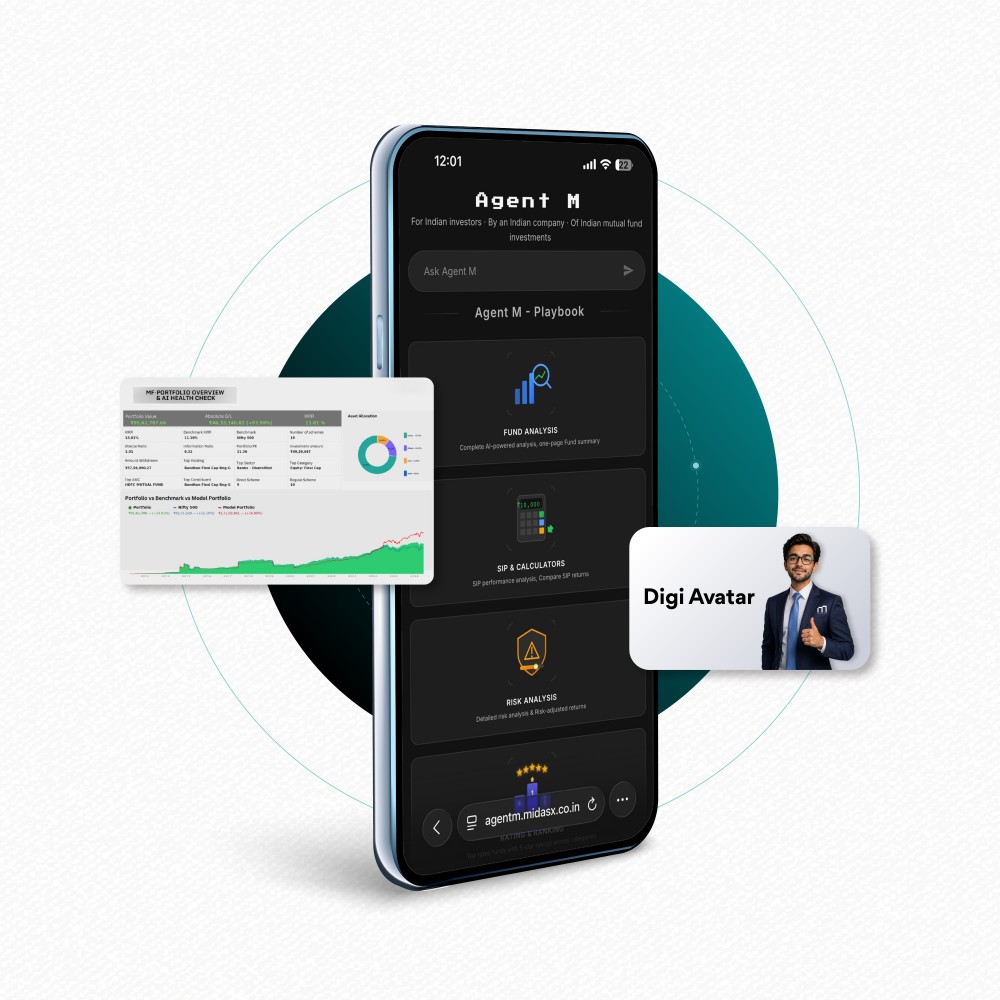
This is where MIDASX adds a new layer of intelligence through Portfolio Genius AI, Agent M and Digi Avatar.
Agent M: Make Research Faster and Smarter
Agent M helps simplify mutual fund research by making relevant information easier to access and understand.
It supports intermediaries in exploring fund-related information, evaluating available options and preparing for client conversations with greater confidence and context.
Portfolio Genius AI: See the Portfolio More Clearly
Portfolio Genius AI helps intermediaries analyse client portfolios with greater speed and clarity. It can bring attention to allocation gaps, concentration concerns and areas that may require a closer review.
This allows intermediaries to spend less time compiling scattered information and more time understanding what the portfolio insights mean for the investor.
Digi Avatar: Make Every Interaction More Personalised
MAGNIX AI brings intelligence and personalisation into the larger Intermediary journey.
It helps intermediaries move beyond standardised communication and create interactions that are more relevant, timely and aligned with the needs of each investor.
Together, these MIDASX solutions help financial intermediaries analyse portfolios better, access research faster and engage clients more meaningfully.
Technology does not replace the financial doctor.
It gives the financial doctor sharper tools to understand every client, identify the right concerns and offer guidance with greater clarity.
The Future Belongs to Those Who Diagnose Better
Financial products will continue to become easier to access, and investment information will become more widely available.
What will remain truly valuable is a financial intermediary who listens carefully, asks the right questions and understands the person behind the portfolio.
With the right judgement, trusted relationships and intelligent support from MIDASX, financial intermediaries can move beyond simply recommending products. They can build more informed, personalised and long-term financial journeys for every client.
Because the right financial advice does not begin with a product.
It begins with understanding the investor.
You are the financial doctor.
And MIDASX gives you the intelligence to diagnose better, research smarter and guide every financial journey more meaningfully.