

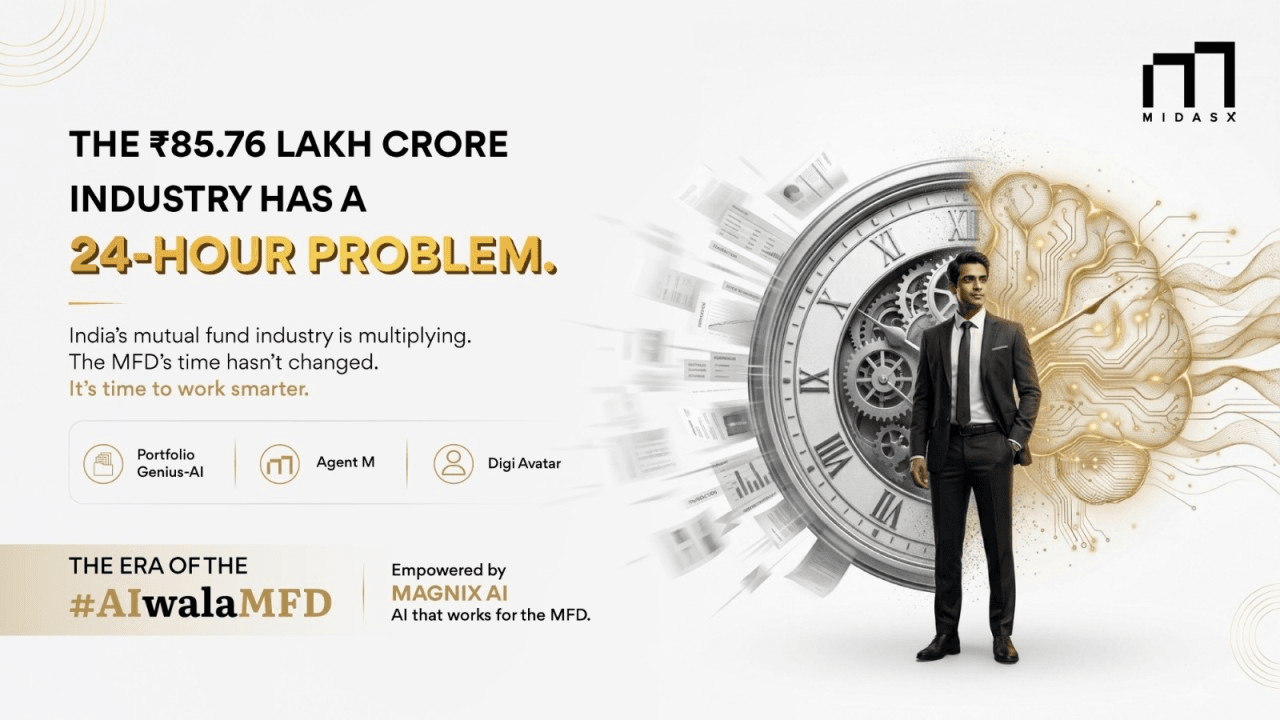
India’s mutual fund industry is growing faster than ever. Investors are multiplying, SIPs are getting bigger, products are becoming more sophisticated and AI is entering the investment journey. But there is one thing that has not grown: the number of hours available to an MFD.
India’s mutual fund growth story is usually told through one number: AUM. And understandably so.
As of July 31, 2026, the Indian mutual fund industry managed ₹85.76 lakh crore in assets. A decade ago, in July 2016, that number stood at approximately ₹15.18 lakh crore. In just ten years, the industry has expanded almost sixfold. At the same time, the total number of mutual fund folios has reached 28.09 crore.
But perhaps the most interesting question today is no longer whether India will invest more.
It is whether the wealth distribution ecosystem can keep up with the India that is investing.
For the MFD, this growth means far more than larger assets. It means more investors to understand, more portfolios to monitor, more transactions to manage, more conversations to initiate and more moments where timely intervention can make a difference. The size of the opportunity is expanding, but so is the complexity of serving it.
The SIP number tells an even bigger story
Monthly SIP contributions reached ₹31,961 crore in July 2026, compared with ₹28,464 crore in July 2025.
It is tempting to see ₹31,961 crore simply as another milestone. For an MFD, however, every SIP represents an ongoing investor relationship.
An investor’s income can change. Goals can evolve. Markets can become volatile. Portfolios can move away from intended allocations. An investor may need reassurance, a review or simply the right conversation at the right moment.
Multiply these moments across hundreds or thousands of relationships and a new challenge begins to emerge.
The industry’s growth is creating an MFD capacity problem.
The first phase of WealthTech helped solve access. Transactions became digital, portfolios became easier to view, reporting became faster and a substantial amount of paperwork moved online.
But the next technology question is very different.
It is no longer enough for a platform to tell an MFD, "Here is everything happening in your business."
The more valuable question is becoming, "Here is what in your business needs your attention today."
That shift, from displaying information to identifying action, could define the next generation of WealthTech.
More opportunity is also bringing more complexity
The investment universe available to Indian investors continues to evolve. A recent example is the emergence of Specialized Investment Funds (SIFs), with SEBI issuing specific certification requirements for their distribution on July 21, 2026.
The significance is larger than one new category.
The wealth ecosystem is becoming more sophisticated. As the range of products, strategies and investor choices expands, an MFD must absorb more information while still maintaining the simplicity and clarity that investors expect.
This creates an unusual equation for the industry:
The opportunity available to the MFD is increasing at exactly the same time as the complexity of serving that opportunity.
And there is another change happening simultaneously.
AI is becoming part of the investor’s world.
Investors are using AI. But they are not replacing human judgement with it.
HSBC’s 2026 global study of nearly 10,000 affluent and high-net-worth investors across ten markets, including India, found that 73% already use AI for finance and investment-related activities.
That number alone might appear disruptive for the traditional wealth intermediary. The rest of the research tells a far more interesting story.
Only 12% said AI was the most influential factor in their last investment decision. When asked where their latest investment idea originated, 62% cited financial professionals and institutions, versus 32% who cited AI. And when investors were asked about the future, 50% said their ideal model was a combination of AI and a human adviser.
Investors also identified reassurance and strategic expertise among the qualities they continue to value from professionals.
That could be one of the most important signals for the Indian MFD ecosystem.
AI does not necessarily make the financial intermediary less relevant. Used correctly, it can make a good intermediary significantly more capable.
An investor using AI can research faster. An MFD using AI can potentially understand an entire book of business faster.
That is a much bigger shift.
The next divide will not simply be digital versus offline
Two MFDs can have the same website, online transactions, client application and portfolio dashboard and still operate very differently.
One may continue to manually search through portfolios, identify opportunities, prepare communication, follow up with clients and determine which relationships require immediate attention.
The other could increasingly have intelligence working alongside them, analysing information, highlighting priorities and helping them enter every client conversation better prepared.
That is the shift from digitisation to intelligence.
And that brings us to perhaps the most important statistic in this entire newsletter.
It is not ₹85.76 lakh crore.
It is not 28.09 crore folios.
It is not ₹31,961 crore in monthly SIP contributions.
It is 24 hours.
Because while the MFD’s AUM can multiply, clients can multiply, products can multiply and data can multiply, the working day cannot.
The answer cannot simply be to ask MFDs to work faster.
The answer has to be to help them work smarter and at a different scale.
This is where the #AIwalaMFD begins
The next generation of MFD technology should not be built around replacing the human relationship at the centre of wealth distribution. It should be built around increasing what that human is capable of doing.
That is the thinking behind MAGNIX AI by MIDASX - an AI ecosystem designed around the everyday realities of an MFD business.
With Portfolio Genius-AI, portfolio data can become more meaningful intelligence, helping MFDs identify insights and opportunities across their client base.
With Agent M, AI becomes an intelligent business assistant, helping an MFD navigate information faster, respond smarter and reduce the time spent searching for what matters.
And with Digi Avatar, communication itself can become more scalable, helping MFDs create a stronger and more personalised digital presence for their investors.
Together, these capabilities point towards a very different idea of AI in wealth distribution.
Not AI instead of the MFD.
AI working for the MFD.
Because the MFD continues to bring what technology cannot manufacture at scale: experience, judgement, context, relationships and trust. MAGNIX AI adds the intelligence and capacity that can help those strengths travel further.
That is what MIDASX means by the #AIwalaMFD
An MFD who can understand more without manually analysing everything. Serve more without making every interaction generic. Communicate more without multiplying the workload. And grow the business without trying to manufacture a 25th hour in the day.
India has already built an ₹85.76 lakh crore mutual fund industry.
The next chapter is about building an MFD ecosystem capable of keeping up with it.
Because the industry can continue to multiply.
The MFD's time cannot. Their capability can.
Welcome to the era of the #AIwalaMFD.
Powered by MAGNIX AI. Built by MIDASX.
MIDASX Experience in Wealth. Edge in Technology.